


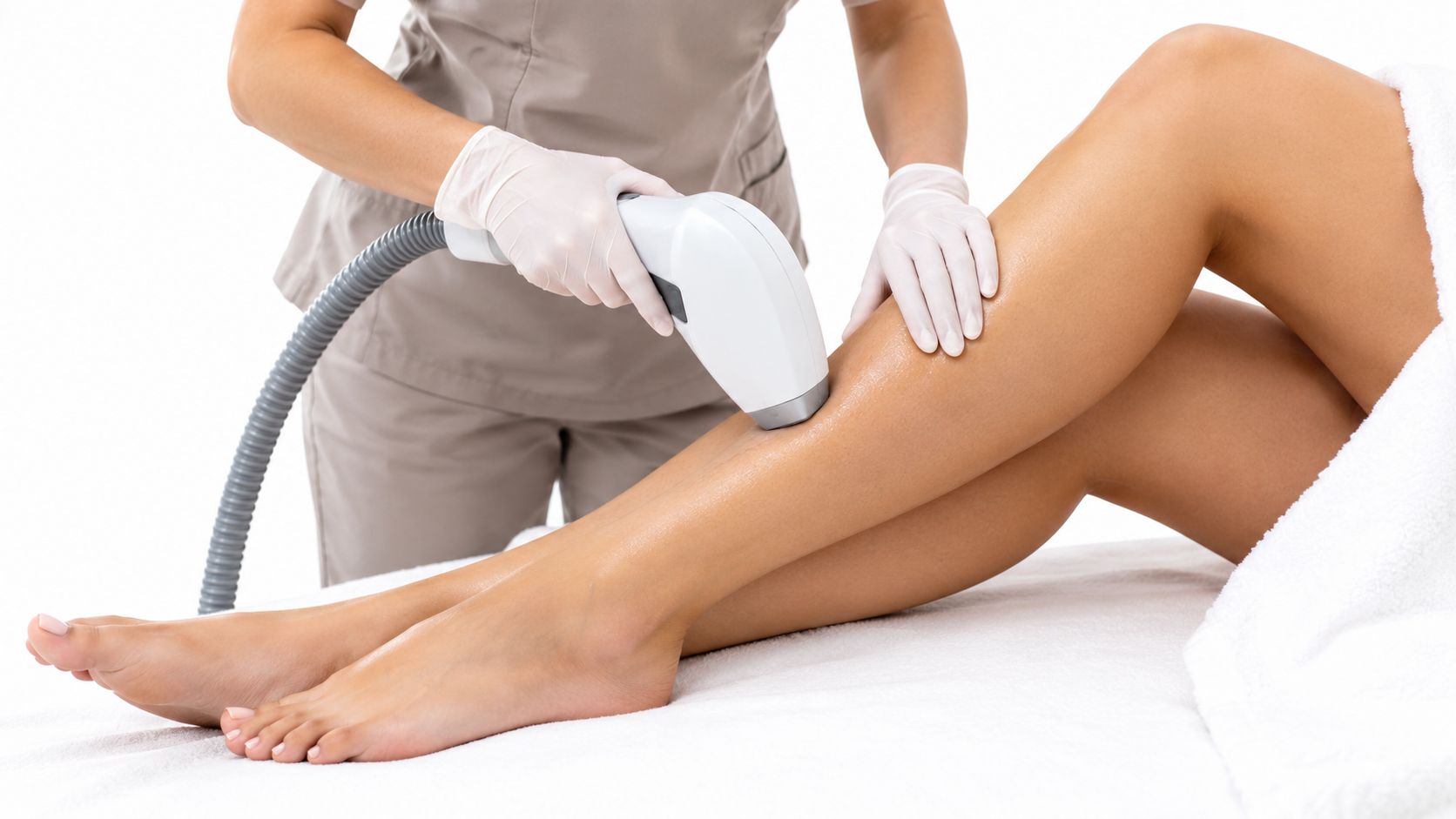
The first consultation about laser hair removal legs usually starts with the same three questions. Will it hurt, how many sessions will it take, and is the device safe for your skin tone? If you live in Dubai or Deira and you're comparing waxing, at-home devices, and clinic-based treatment, the answer depends less on marketing and more on wavelength choice, skin type, hair density, and consistency.
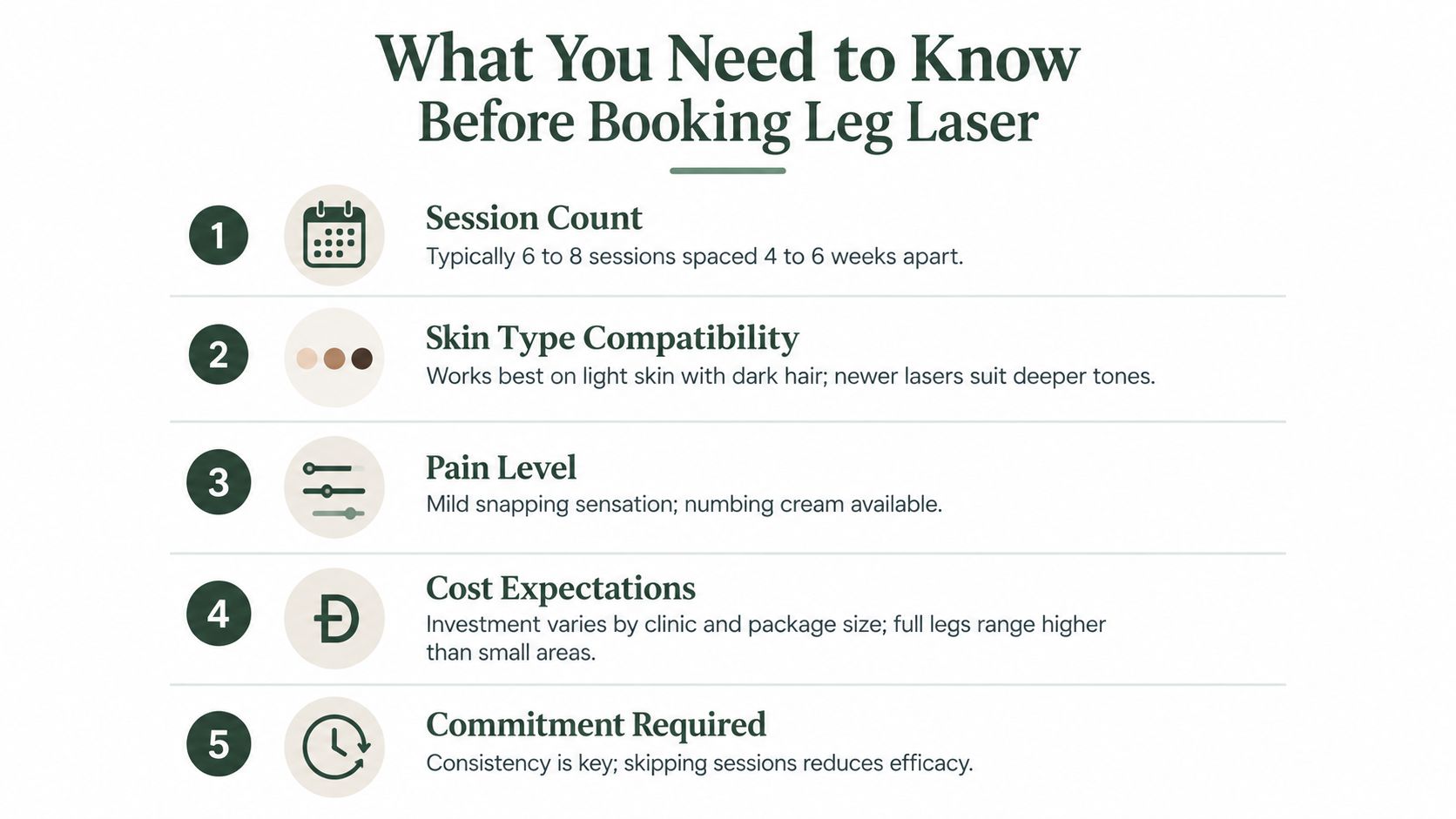
Table of Contents
- What You Need to Know Before Booking Leg Laser
- How Laser Hair Removal Targets Leg Hair
- Why Wavelength Choice Matters More on Legs
- Session Count, Timing, and Appointment Length for Legs
- Pain Levels and What the Treatment Actually Feels Like
- Realistic Results and Maintenance Over Time
- Aftercare, Sun Protection, and Recovery in the UAE
- Practical Patient Questions and Next Steps
What You Need to Know Before Booking Leg Laser
The biggest mistake first-time patients make is treating full-leg laser like a quick beauty add-on. Legs are a large treatment area, so session count, pain tolerance, downtime, cost structure, and wavelength match matter more than they do for smaller zones like underarms. A good consultation should answer all five before you commit.
Start with the practical questions
If you're torn between salon waxing and clinic laser, compare what happens over time, not just what happens on day one. Waxing removes hair that's already visible, while laser aims at the follicle itself, which is why the plan is built around repeat visits instead of one-off appointments. For a useful comparison of those trade-offs, see the clinic's guide to laser vs waxing.
Practical rule: don't book full legs based on price alone. Ask which laser is being used, how the clinic adapts it to your skin tone, and whether the plan is written out before treatment starts.
The other decision point is commitment. A full-leg package usually means several visits, not a single appointment, and skipping sessions can slow progress. That matters in the UAE, where legs are often exposed to sun, which affects how safely a clinic can treat you.
A sensible first appointment should include a skin assessment, a discussion of your hair pattern from thigh to ankle, and a realistic explanation of what the first few sessions will feel like. If a provider says “one size fits all,” that's a warning sign, especially for darker skin tones.
How Laser Hair Removal Targets Leg Hair
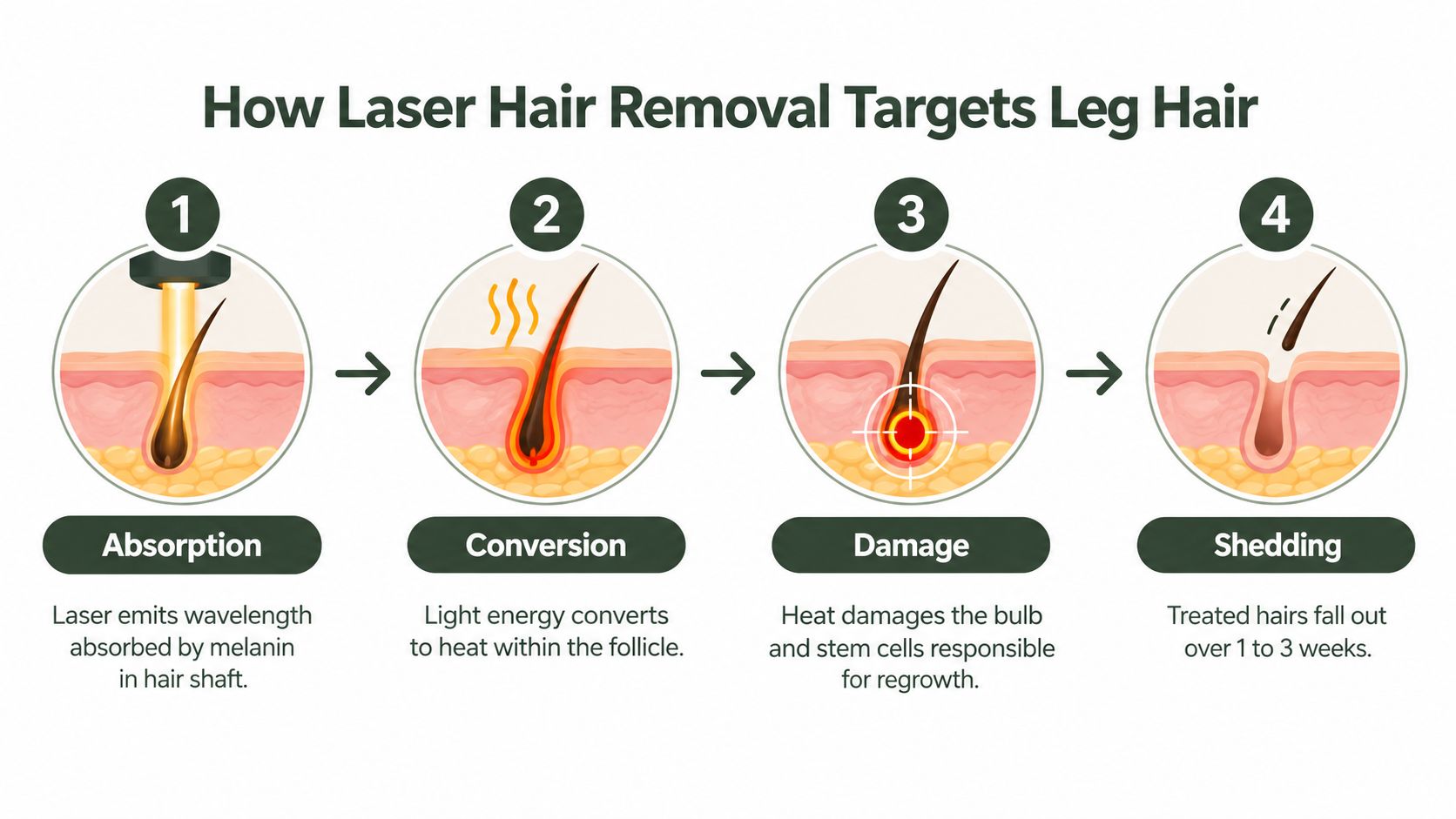
Laser works by aiming light at melanin, the pigment in the hair shaft. The energy turns into heat inside the follicle, and that heat disrupts the structures that keep the hair growing. The surrounding skin should stay protected when the settings are correct and the operator knows how to match the wavelength to the patient.
Why only some hairs respond at each visit
Hair doesn't grow in a single uniform wave. It moves through anagen, catagen, and telogen phases, and laser can only really target follicles that are still connected to a pigmented hair shaft in an active growth phase. That's why one appointment never clears everything.
Leg hair makes this more obvious because the growth pattern is patchy and staggered across a large area. One patch may be active while the one beside it is resting, so the same calf or thigh needs to be revisited several times before most visible hair has been reduced.
Treated hairs don't vanish instantly. They usually shed gradually after the session, which is why patients sometimes think nothing happened at first.
Terminal hair on the legs usually responds better than very fine vellus hair. That distinction matters, because some patients expect the laser to remove every single faint strand, but lighter fine hair can be stubborn no matter how good the device is.
Why Wavelength Choice Matters More on Legs
The question for leg treatment isn't just which machine the clinic owns, it's which wavelength they use and when they switch between them. That matters because legs often combine coarse hair, large surface area, and variable sun exposure, which changes how much pigment the skin itself contains at the time of treatment.
The three main options in plain language
Alexandrite at 755 nm is fast and works well when there's strong contrast between lighter skin and darker hair. It's a good match for some fair to olive skin types, but the burn risk rises as skin tone deepens or recent tanning is present.
Diode around 800 to 810 nm sits in the middle. It's often used as a flexible option across mixed skin types, especially when a clinic wants one platform that can work across different body areas.
Nd:YAG at 1064 nm is the safer choice for darker skin because it bypasses more of the epidermal pigment and reduces the chance of overheating the skin surface. In the UAE, that makes it especially relevant for Fitzpatrick V to VI skin and for patients with recent sun exposure.
| Wavelength | Best For | Speed on Legs | Safety on Darker Skin |
|---|---|---|---|
| Alexandrite | Light to olive skin with dark hair | Fast on large surfaces | Lower margin when skin tone deepens |
| Diode | Mixed skin types and variable hair calibre | Moderate to fast | Better than Alexandrite for some deeper tones |
| Nd:YAG | Darker or tanned skin | Usually slower, but safer for pigment-rich skin | Strongest safety profile for deeper tones |
The device brand matters less than the setting and wavelength choice. A clinic can own a premium platform and still use it poorly, while a well-trained operator with the right protocol can treat a large leg area more safely and consistently. For a deeper comparison of those wavelengths, the clinic's diode versus Alexandrite guide is useful background.
Session Count, Timing, and Appointment Length for Legs
A full-leg plan usually needs patience. Sessions are typically 6 to 10, with early visits spaced about 4 to 6 weeks apart and later visits stretching to 6 to 8 weeks as hair density drops and growth slows. That timing isn't arbitrary, it follows the hair cycle on the legs.
What the first appointments actually look like
The first session often takes longer because the clinician is doing more than firing the laser. There's consent, medical history, a skin and hair assessment, and sometimes photography or a patch test before the full area is treated. Once the plan is underway, the appointment becomes more predictable.
| Area | Typical Sessions | Interval Between Sessions | Time per Appointment |
|---|---|---|---|
| Full legs | 6 to 10 | 4 to 8 weeks | 45 to 90 minutes |
| Lower legs | 6 to 10 | 4 to 8 weeks | 20 to 40 minutes |
| Thighs only | 6 to 10 | 4 to 8 weeks | 25 to 45 minutes |
Clinical reality: appointment length depends on hair density, the device head size, and how carefully the operator overlaps each pass. Large areas reward a steady pace, not rushing.
A few things can push the session count higher. Hormonal hair growth, PCOS-related hair patterns, very dense coarse hair, and changing devices halfway through a plan can all make the journey longer. Clinics that promise a fixed number for everyone are oversimplifying a treatment that depends on biology.
For readers comparing costs across different laser categories, it helps to remember that pricing usually tracks area size, number of visits, and technology. A pricing article such as erbium laser treatment pricing can be helpful for understanding how area-based treatment costs are often structured in aesthetic services more broadly.
Pain Levels and What the Treatment Actually Feels Like
Most patients describe leg laser as a series of quick hot snaps. The sensation is often compared to a rubber band flick, but that comparison only goes so far, because the response changes from the shin to the calf to the thigh.
Where it feels strongest
The shin and knee are usually the most sensitive because bone sits close to the surface and there's less soft tissue to buffer the pulse. The calf is usually more moderate, and the thigh is often the easiest area to tolerate. Hair density also matters, because thick coarse leg hair tends to sting more at the beginning than sparse regrowth does later on.
The treatment itself moves in a glide-and-pulse rhythm. Cooling is applied before, during, or after the pulse, depending on the platform, and the technician may change fluence in real time if one patch is more reactive than another. That adjustment is one reason a trained operator matters so much.
Topical numbing cream is rarely needed for legs. It can make absorption uneven over a large area, and cooling systems usually do enough to keep the session manageable. Built-in sapphire tip cooling and air cooling are doing the main work here, not a numbing cream layer.
Most people don't describe leg laser as pleasant, but they do describe it as manageable. The first visit is usually the one patients overthink the most.
Realistic Results and Maintenance Over Time
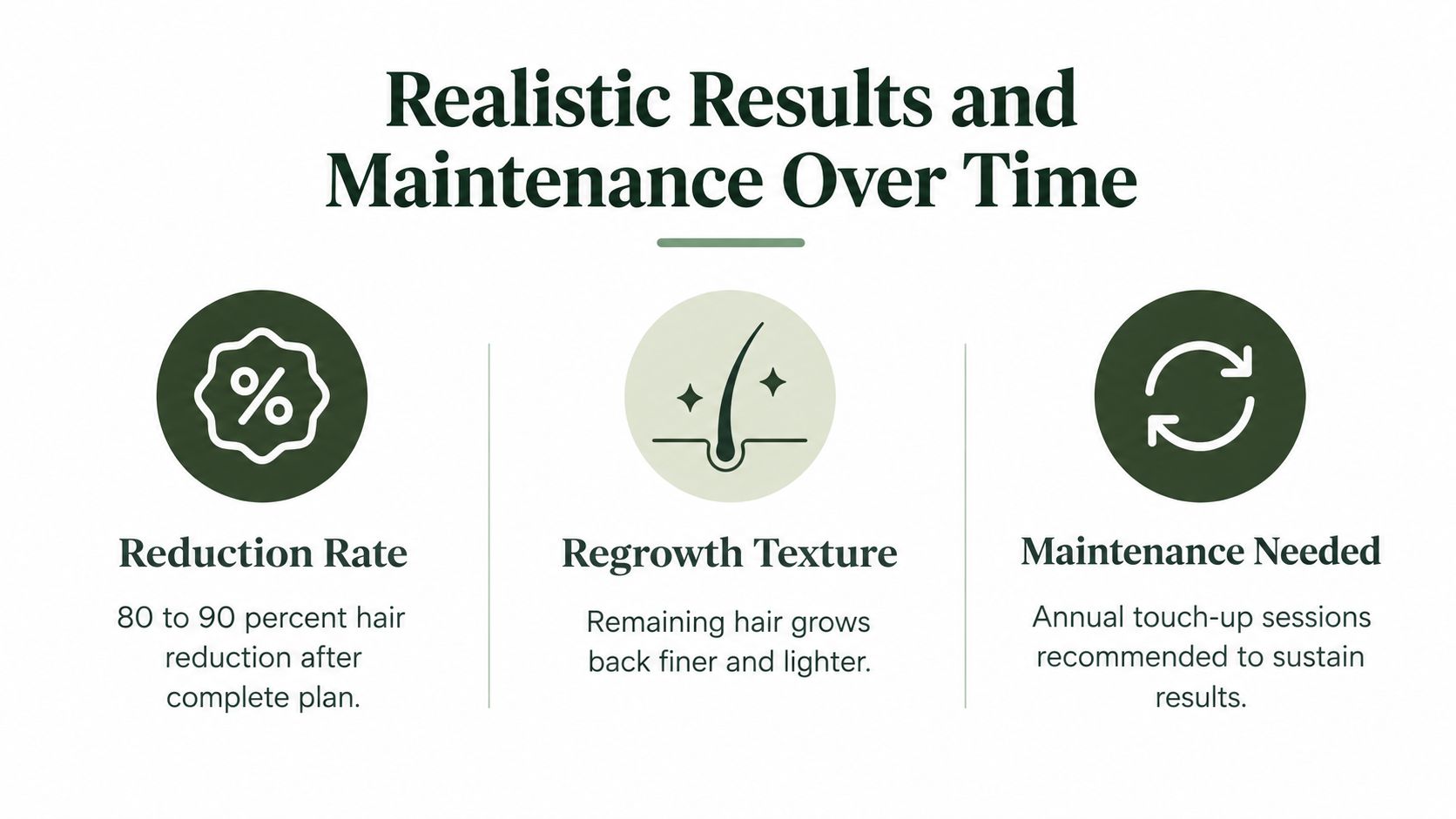
The best way to judge progress is by the shape of the regrowth, not by expecting total smoothness after one or two visits. After a complete plan, many patients see roughly 80 to 90 percent hair reduction. The remaining hair is usually finer, lighter, and slower to return.
What tends to improve first
Shins and calves often respond most predictably because the hair pattern is clearer and the terminal hair is easier to target. Thighs can be less dramatic, especially where finer hair or hormone-driven changes are part of the picture. That doesn't mean the treatment failed, it usually means the biology is different in that area.
Visible thinning often starts by session three, major reduction usually becomes obvious by session six, and the last two or three visits are about refinement. After the main plan, many patients need one touch-up session every 6 to 12 months, sometimes yearly, depending on hormones, age, and whether they completed the full course.
The distinction between permanent reduction and permanent removal matters. Destroyed follicles don't regenerate, but dormant follicles can reactivate later if hormones change, such as after pregnancy, menopause, or medication changes. That's why maintenance is part of the plan, not a failure of the plan.
For a visual sense of progression, laser hair removal before and after can help readers understand how gradual the change usually is.
Aftercare, Sun Protection, and Recovery in the UAE
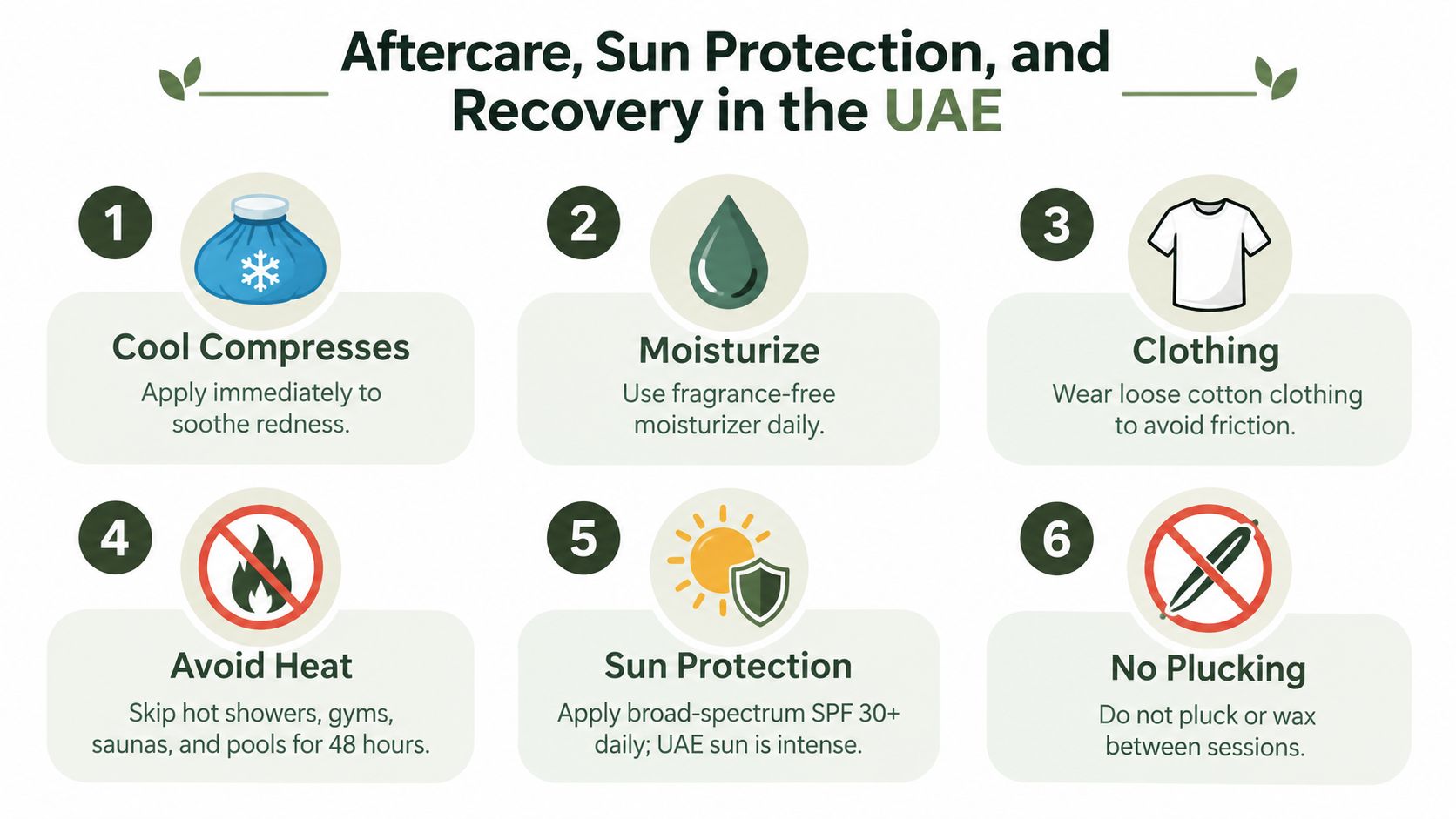
The first 48 hours after treatment are about calming the skin down. Cool compresses, a fragrance-free moisturiser, and loose cotton clothing are the basics. Hot showers, gyms, saunas, and swimming pools should wait, because heat and friction can make irritation worse.
What recovery usually looks like
Redness often settles within hours. Follicular swelling, which looks like tiny raised dots, usually fades by day two or three. Any temporary darkening of the treated hairs typically sheds over one to two weeks.
In the UAE, sun protection is essential because outdoor exposure can raise the risk of post-inflammatory pigmentation. Legs are easy to forget under trousers, skirts, or brief outdoor transitions, so broad-spectrum SPF 50+ on exposed skin is the safer habit. If the skin is still reactive, that matters even more than usual.
Shaving is usually the hair-removal method to return to between sessions, while waxing and plucking should be avoided because they remove the follicle target the laser needs. Retinoids, AHAs, and other exfoliating actives should also be paused around treatment time if the area is being irritated. If you're unsure, the clinic should give you a simple written pre- and post-care sheet.
Sun exposure is the recovery issue patients underestimate most in Dubai. The laser may be over in minutes, but the skin still needs discipline for the next few days.
Practical Patient Questions and Next Steps
A responsible consultation should feel structured, not rushed. The provider should review your medical history, assess your skin tone with a Fitzpatrick-type lens, consider a patch test on the inner thigh or calf if your skin is reactive, and give you a written plan with the projected session count. If that doesn't happen, ask more questions before paying for a package.
What to ask before you book
- Will you patch test first? This is especially useful for darker skin tones or if you tan easily in the UAE sun.
- Which wavelength will you use on my legs? The answer should make sense for your skin tone and hair calibre.
- How do you structure pricing? Some clinics price per session, others use packages of six to eight, and some add annual maintenance visits.
- Can I see similar skin types in before-and-after photos? That's more useful than generic images.
- Who performs the treatment and how is the device maintained? You want a clear answer, not vague reassurance.
| Treatment Area | Typical Session Time | Average Sessions Needed |
|---|---|---|
| Full legs | 45 to 90 minutes | 6 to 10 |
| Lower legs | 20 to 40 minutes | 6 to 10 |
| Thighs only | 25 to 45 minutes | 6 to 10 |
Pricing in Dubai is usually shaped by the area size, package structure, and the technology used, so full legs cost more in time and resources than smaller zones. That's why it makes sense to compare full-leg, half-leg, and lower-leg-only plans against your actual hair growth pattern rather than buying the biggest package by default. A clinic should help you match the treatment area to the actual issue, not the marketing label.
If you're still deciding, ask for a patch test rather than committing to a full package on day one. A careful consultation at a doctor-led clinic in Deira can save you from the wrong wavelength, the wrong area size, or the wrong expectations. If you're planning treatment in Dubai, a visit to Yoyime Clinic can help you review your skin type, talk through your leg-hair pattern, and choose a sensible plan before you start.