


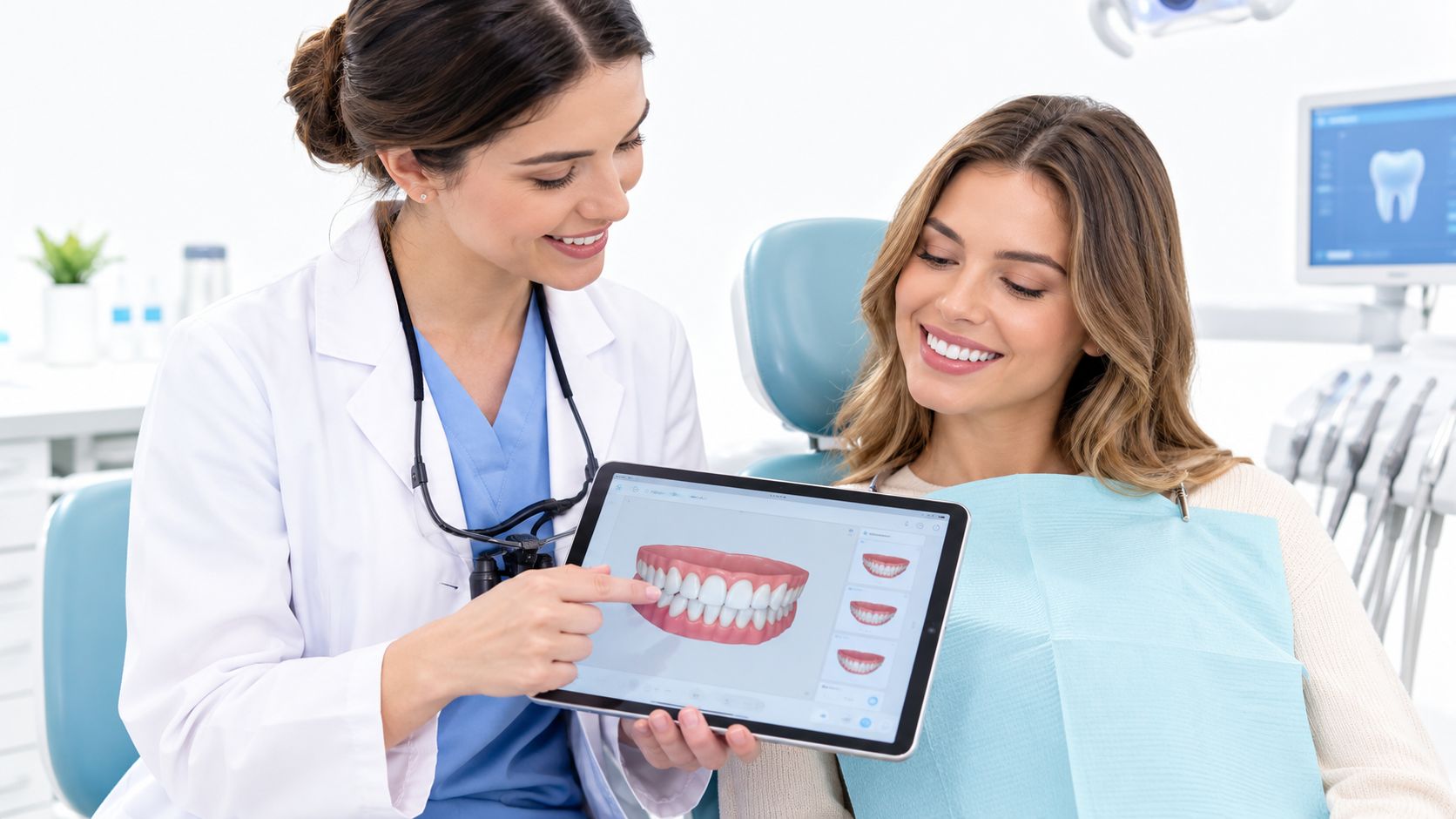
You've probably seen the same promises repeated across Dubai: a brighter smile, straighter teeth, veneers completed quickly, and a polished “smile makeover” package. The difficult part isn't finding an aesthetic dental clinic. It's deciding whether the clinic is planning for healthy function, suitable materials, gum stability and long-term maintenance, or just selling a fast cosmetic result.
A sound choice starts with a dental examination, not a treatment menu. The dentist should identify decay, gum disease, worn enamel, bite problems, cracks and missing teeth before discussing whitening, bonding, veneers or clear aligners. That doctor-led order matters because an attractive result built on untreated disease can become uncomfortable, difficult to maintain or unsuitable for your bite.
Dubai offers a deep clinical environment for dental care. The emirate had 4,069 licensed dentists in 2023 and about 46% of the UAE's healthcare facilities, according to UAE dental-services market information. That gives patients choice, but it also makes careful comparison essential.
Table of Contents
- Defining a Modern Aesthetic Dental Clinic
- Core Cosmetic Services and Smile Enhancements
- The Doctor-Led Pathway to Smile Design
- Navigating Treatment Costs and Financial Planning
- The Reality of Aftercare and Long-Term Maintenance
- How to Verify Clinic Credentials and Standards
- Common Questions About Aesthetic Dentistry
Defining a Modern Aesthetic Dental Clinic
A patient can request veneers and leave with a different diagnosis: gum inflammation, uneven tooth wear, or an untreated cavity may be driving the concern. A modern aesthetic dental clinic must be equipped to identify and manage those problems before proposing cosmetic treatment. The clinic's priority should be complete oral care, with appearance addressed only after health and function are understood.
The clinical sequence matters. The dentist should assess the teeth, gums, bite, supporting structures, existing restorations, and the patient's expectations before discussing colour, shape, alignment, or proportions. Active gum disease may require periodontal treatment first. An unstable bite may call for orthodontic or restorative planning before veneers or bonding are considered.
Dubai has developed a broader range of specialised dental facilities. Dubai Dental Hospital was inaugurated on 28 January 2019 as the first and largest dental hospital in Dubai, marking the emirate's investment in larger oral-care facilities. This development does not make every clinic appropriate for cosmetic treatment. It does give patients access to practices with different expertise and, where needed, coordinated care across dental disciplines.
What a genuine clinical approach includes
Ask the clinic to explain:
- The starting condition: Which teeth are healthy, which need treatment, and whether the gums are stable.
- The functional limits: How your bite, tooth thickness, jaw movement, and existing restorations affect the available options.
- The conservative alternative: Whether whitening, alignment, or composite bonding could meet your goal while preserving more natural tooth structure.
- The maintenance plan: What daily care, professional reviews, repairs, or replacements may be required after treatment.
- The reasons for saying no: A careful dentist should decline an elective procedure when it could weaken teeth, irritate the gums, or create functional problems.
The clinical guide to bespoke aesthetic dentistry reflects this patient-specific approach. A natural-looking result should be planned around the patient's face, teeth, gums, bite, and ability to maintain the work. A template copied from a celebrity image rarely accounts for those clinical limits.
Practical rule: If a consultation begins with a fixed package before anyone examines your mouth, treat it as a warning sign.
Core Cosmetic Services and Smile Enhancements
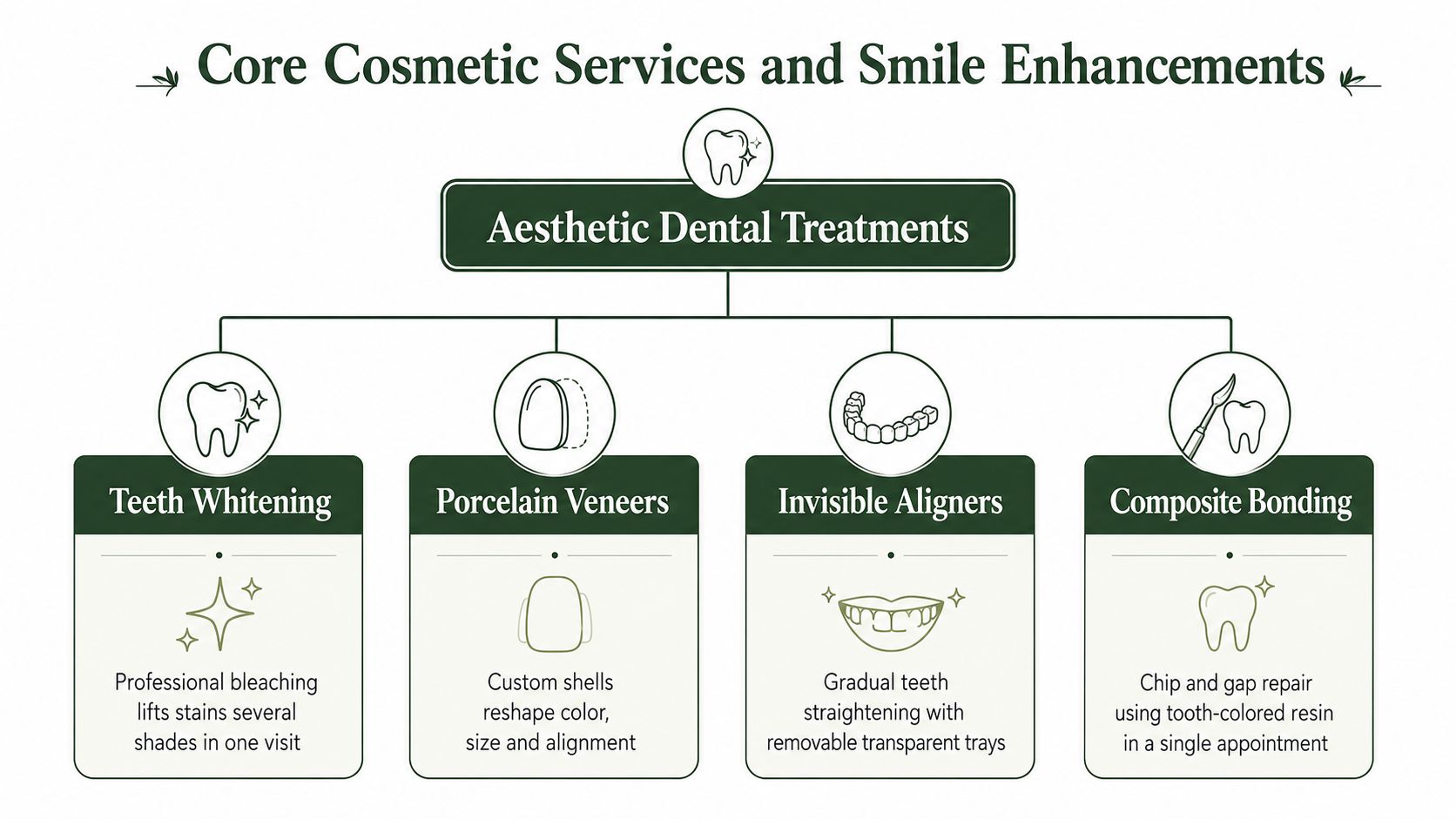
Cosmetic dentistry solves different problems with different levels of intervention. Whitening changes colour. Bonding reshapes small areas. Veneers alter the visible surface of selected teeth. Clear aligners move teeth gradually. None of these treatments is a universal answer, and each works best when the teeth and gums are healthy enough to support it.
Professional teeth whitening
Professional whitening is usually considered when the main concern is staining or overall tooth colour. The dentist assesses the enamel, existing fillings, crowns and sensitivity risk before selecting an appropriate bleaching approach. It can lighten natural teeth, but it won't change the colour of tooth-coloured restorations, and the result can fade as new staining develops.
Sensitivity is possible, particularly when the teeth already react to cold drinks or brushing. A dentist can adjust the approach, address exposed root surfaces and explain how to manage discomfort rather than promising a completely sensitivity-free experience. Patients researching the technology and process can review this independent explanation of buy Zoom whitening from DentalHealth.com, but product names and treatment suitability still need to be confirmed by your treating dentist.
Porcelain veneers
Porcelain veneers are thin, custom-made shells bonded to the front of selected teeth. They may improve colour, shape, minor spacing and certain alignment concerns, but they're not a substitute for orthodontics in every case. Veneers also require careful assessment of enamel, bite forces, tooth position and habits such as clenching.
The key limitation is that veneer treatment may involve altering natural tooth structure, depending on the design and the tooth's starting position. A dentist should explain what will be removed, which teeth are involved, how the shade will be selected and what happens if a veneer chips or needs replacement.
Composite bonding
Composite bonding uses tooth-coloured resin that the dentist places, shapes and polishes directly on the tooth. It can be useful for small chips, modest gaps, uneven edges and limited shape changes. It's often more conservative than a veneer because the dentist may be able to preserve more natural enamel.
Bonding can stain, wear or chip, especially around the biting edges or in patients who grind their teeth. It's best viewed as a targeted repair or reshaping option, not as a permanent solution for every cosmetic concern.
Clear aligners
Clear aligners apply controlled pressure to move teeth gradually. They may suit adults with selected spacing, crowding or alignment problems, provided the gums and supporting bone are healthy. They must be worn as directed and removed for eating and oral hygiene, and not every bite or tooth movement can be managed with aligners alone.
You can explore Yoyimé Clinic's cosmetic dentistry services, then use a consultation to determine whether whitening, bonding, veneers, alignment or a phased combination is clinically appropriate. The correct plan should improve appearance without sacrificing cleaning access or comfortable function.
The Doctor-Led Pathway to Smile Design
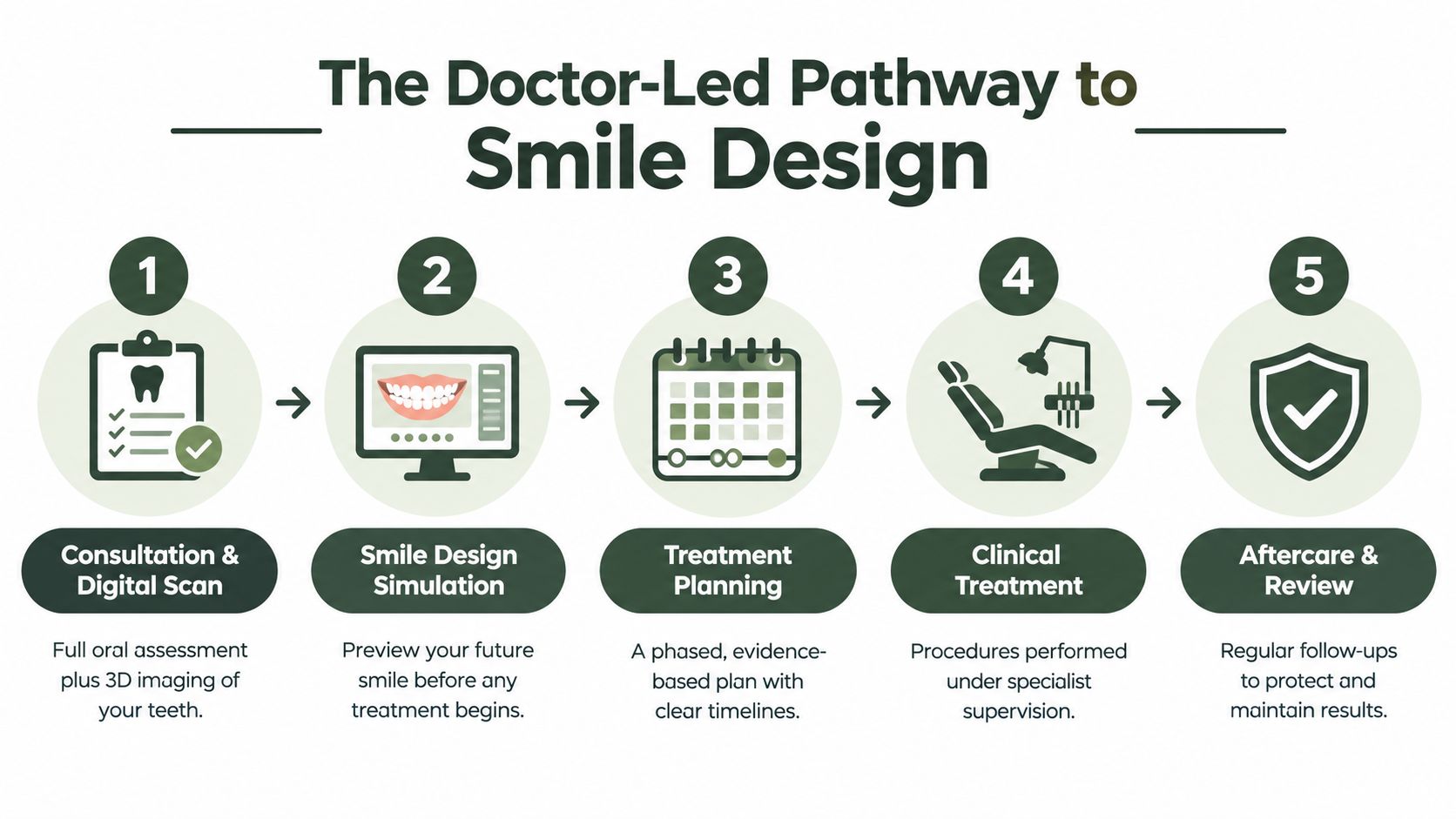
A proper smile design is a diagnostic process before it becomes a cosmetic procedure. The dentist needs to understand what you want to change, what your mouth can safely support and which sequence will produce a stable result.
Start with examination and records
The first appointment should include a discussion of your goals and a clinical assessment. Depending on the proposed treatment, the dentist may use photographs, radiographs, digital scans, bite records or models. These records help identify problems that aren't obvious when you look in the mirror, including hidden decay, gum recession, worn edges and uneven contact between teeth.
A simulation can help you understand a proposed direction, but it's a planning aid, not a promise. The final appearance depends on tooth biology, available space, gum position, material limitations, facial movement and your ability to maintain the result.
Build the sequence around oral health
A complex plan may involve more than one discipline. Periodontal care may be required to control gum inflammation. Orthodontics may create space or improve tooth position. Restorative dentistry may repair damaged teeth before cosmetic finishing. Prosthodontic planning can help coordinate the shape, contact points and bite of multiple restorations.
The dentist should explain the order in plain language:
- Stabilise disease: Treat decay, infection or gum problems first.
- Improve position where needed: Use orthodontic treatment if tooth movement will produce a safer or more conservative result.
- Refine shape and colour: Consider whitening, bonding or veneers only after the foundation is stable.
- Review function: Check comfort, speech, chewing and bite contacts.
- Plan maintenance: Set out reviews, hygiene appointments and protection against wear.
See the Yoyimé Clinic doctors to understand who you'll meet, then ask which clinician will coordinate the overall plan. A named clinical lead reduces the risk of fragmented decisions when several treatments are involved.
A visual preview can be useful, especially when several teeth are changing. It should support informed consent, not replace it. You should still receive an explanation of alternatives, limitations, likely maintenance and the possibility that the final result will differ from a digital image.
Here's a short visual introduction to how treatment planning may be presented:
Navigating Treatment Costs and Financial Planning
Cosmetic dental budgeting becomes clearer when you separate medical necessity from elective enhancement. A filling, root canal or crown may be needed to restore health and function. Whitening, veneers and some forms of bonding are usually chosen to change appearance. A treatment plan may contain both categories, but they shouldn't be presented as if insurance treats them in the same way.
The updated mandatory basic health insurance plan in the UAE in 2025 caps annual dental benefits at AED 500 and excludes cosmetic services, according to this UAE cosmetic dentistry market report. That means patients considering elective smile treatment should plan around personal funds unless their specific policy states otherwise. Don't assume that a dental package, consultation or restoration is covered just because it's provided by a licensed clinic.
Compare the purpose before comparing the quote
| Treatment Category | Primary Goal | Typical Insurance Status |
|---|---|---|
| Medically necessary dental care | Treat disease, pain, infection, structural damage or impaired function | May have limited cover, depending on the policy and clinical indication |
| Elective cosmetic dental care | Improve colour, shape, spacing or the visual balance of the smile | Often excluded from basic cover |
| Mixed treatment plan | Restore health first, then complete cosmetic refinement | Each component may be assessed differently |
A reputable clinic should provide an itemised plan. Ask whether the fee includes diagnostic records, temporary restorations, laboratory work, fitting, adjustments and reviews. Clarify what happens if the plan changes after examination, or if you decide to complete treatment in stages.
Staging can be clinically sensible
Staging isn't only a financial tactic. It can allow the dentist to treat disease, assess healing, test a conservative change and review how your bite responds before moving to more extensive work. For example, professional cleaning and gum treatment may come before whitening, while alignment may come before veneers if tooth position is the main concern.
Ask for three clear options where appropriate: the most conservative approach, the recommended approach and the more extensive alternative. You'll then be able to compare not only the fees, but also tooth preparation, treatment time, maintenance and future repair obligations.
The Reality of Aftercare and Long-Term Maintenance
A smile makeover isn't finished when the final restoration is fitted or the last aligner is delivered. It enters a maintenance phase. Patients who travel to Dubai for treatment, or residents with demanding schedules, need to understand follow-up before committing to a plan.
Dubai's medical-tourism market is growing, and dental services form a substantial part of that demand. A market report states that 29% of medical tourists in Dubai seek dental services, while Dubai welcomed 691,000 medical tourists in 2023, according to United Arab Emirates dental-clinics market information. Those figures make continuity of care a practical issue, not a minor administrative detail.
Every treatment has a maintenance pattern
Veneers require careful brushing, cleaning between teeth and regular review of the gums and bite. A veneer can chip or debond, and the underlying tooth can still develop decay. Patients who clench or grind may need a professionally designed protective appliance, particularly at night.
Clear aligners demand consistent wear, good cleaning and attendance at review appointments. Teeth can move after active alignment, so retention is part of the treatment, not an optional extra. If an aligner is lost or no longer fits, contact the clinic rather than forcing it.
Whitening needs realistic upkeep. Coffee, tea, smoking and strongly coloured foods can contribute to new staining, while sensitivity may recur with repeated or poorly supervised bleaching. Your dentist should advise whether and when a maintenance treatment is suitable.
Local access changes the risk calculation
A clinic near your home or workplace can make reviews, adjustments and hygiene visits easier. That matters if a restoration feels high, an aligner develops a fitting problem, a gum area remains inflamed or a tooth becomes sensitive after treatment. Remote advice can help, but it doesn't replace an examination when something changes.
Patients combining procedures should also ask how the timelines interact. Orthodontic movement, periodontal treatment, whitening and restorative work may need to occur in a specific order. A clinic that coordinates these stages can reduce unnecessary handoffs and make aftercare responsibilities easier to follow.
A short treatment schedule is only convenient if the follow-up plan is equally clear.
Before you book, request written answers to these questions:
- Review schedule: When will the dentist check the result?
- Repair process: Who will assess a chip, loose veneer or broken retainer?
- Travel timing: How long should you remain available locally after treatment?
- Maintenance: Which hygiene visits, retainers or protective appliances will you need?
- Continuity: What records can be shared with a dentist elsewhere if you return home?
How to Verify Clinic Credentials and Standards
A polished website can't confirm clinical quality. In Dubai, the basic safety check is licensing. Executive Council Resolution No. 49 of 2024 states that a facility may not conduct health activities without a DHA licence, an individual may not practise without a licence, and a facility may not engage an unauthorised health professional. The resolution also states that repeat violations within one year can double fines up to AED 200,000 for professionals and AED 400,000 for facilities, as set out in the Dubai regulation governing health-profession practice%20of%202024%20Regulating%20the%20Practice%20of%20Health%20Professions.html).
Use a practical verification checklist
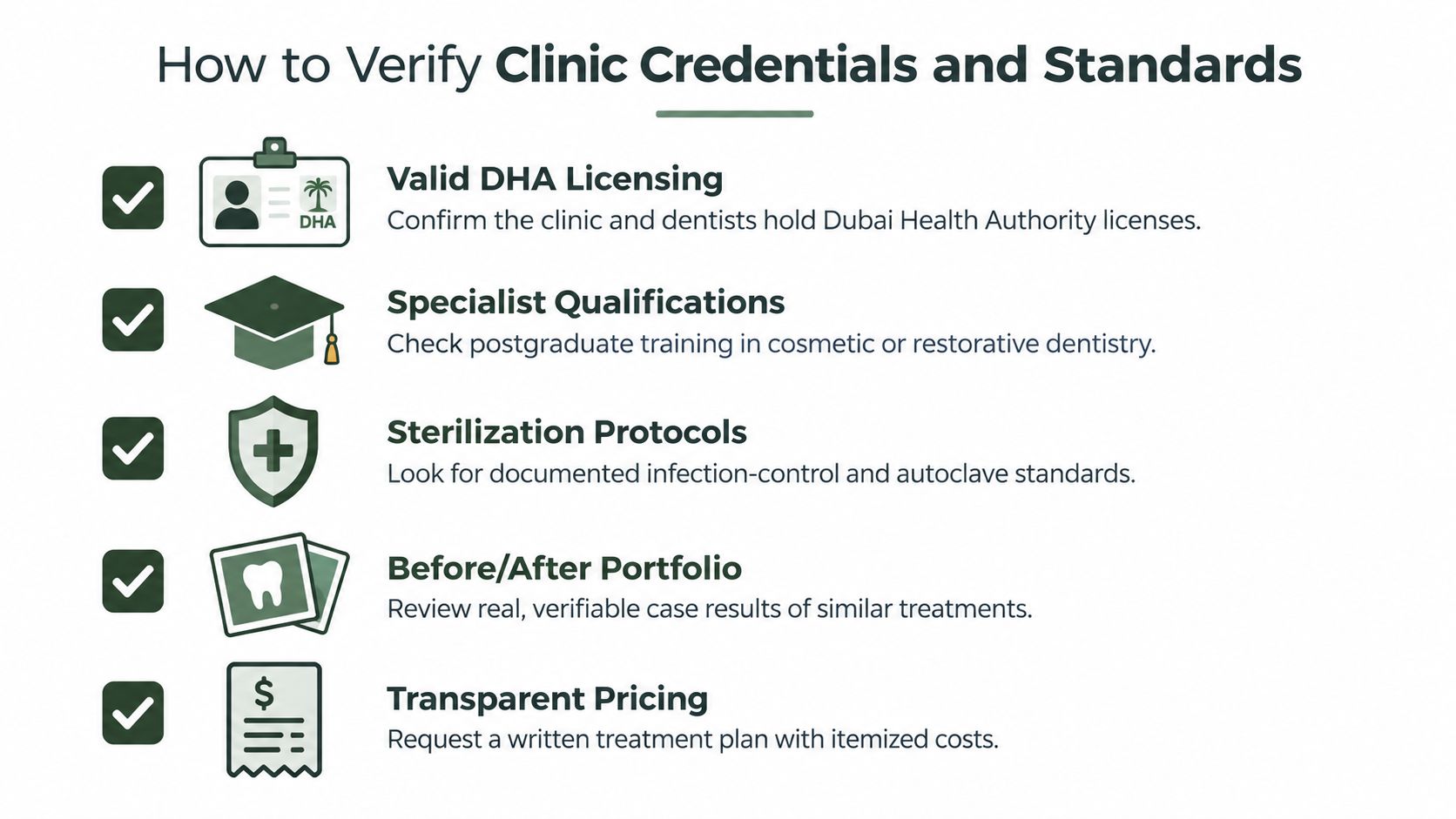
- Confirm DHA licensing: Ask whether both the facility and the treating dentist hold current Dubai Health Authority licences.
- Check relevant training: Find out whether the clinician's experience matches your proposed treatment, particularly for complex restorative or orthodontic work.
- Ask about infection control: The clinic should be able to explain instrument sterilisation, surface disinfection and single-use items.
- Understand laboratory arrangements: For veneers, crowns and other laboratory-made restorations, ask how impressions or digital scans are transferred, how shades are approved and who handles adjustments.
- Request written pricing: The plan should identify each procedure, laboratory component, review and likely maintenance item.
DHA outpatient standards include facility-level licensing criteria, administrative procedures and compliance requirements for dental services, as described in the DHA outpatient standard. Patients don't need to interpret every regulation, but they should expect a clinic to operate within documented standards rather than relying on informal assurances.
Inspect the consultation experience
Notice whether the clinician asks about medical history, medications, previous dental work, grinding, sensitivity and your expectations. A rushed consultation that focuses only on photographs or a discounted package doesn't give you enough information to consent properly.
Ask to see examples of cases similar to yours, but interpret before-and-after images carefully. The photos should be genuine, consistent and relevant to your tooth condition, gum display, shade and treatment type. A portfolio can demonstrate style and workmanship, but it cannot predict your individual result.
Privacy also matters. Dental photography, scans and treatment discussions involve personal health information. The clinic should provide a private setting and explain how your records and images are handled.
Common Questions About Aesthetic Dentistry
How long do porcelain veneers last?
There isn't one guaranteed lifespan for every veneer. Longevity depends on preparation, bonding, bite forces, oral hygiene, gum health, material quality and habits such as nail biting or using teeth to open packaging. A veneer can still require repair or replacement, and the supporting tooth remains vulnerable to decay if cleaning is inadequate.
Ask how the dentist will protect the margins, assess your bite and manage clenching. Regular examinations and professional hygiene support the result, but they can't eliminate all repair risk.
Are clear aligners suitable for adults?
Many adults may be suitable for clear aligners, particularly when the concern involves selected spacing or crowding. Suitability depends on gum health, bone support, tooth roots, bite complexity, existing restorations and the movements required. Some cases need fixed braces, restorative treatment or a combined approach instead.
The dentist should examine your mouth and explain the expected wear routine, attachments if required, retention after alignment and what happens if a tray stops fitting. Age alone isn't the deciding factor.
What should I do about sensitivity after professional whitening?
Mild, temporary sensitivity can occur after whitening. Tell the dentist if you already have sensitive teeth, exposed roots, cracks, decay or defective fillings, because these problems may need attention before bleaching.
Follow the instructions for the prescribed product and avoid using stronger or more frequent applications without clinical advice. Contact the clinic if sensitivity is severe, persistent or localised to one tooth, as that pattern may indicate a separate dental problem.
Can cosmetic treatment improve an unhealthy smile?
Cosmetic procedures shouldn't be used to hide active decay or gum disease. Dubai Health Authority data recorded 2,068,235 dental clinic visitors in 2022, up from 1,673,686 in 2021, with 88.4% of treatments delivered in the private sector and consultations representing 24.8% of oral and dental treatments, according to the Dubai Health Statistical Annual Book. A consultation-led approach gives the dentist a chance to stabilise oral health before recommending elective changes.
For patients with gum concerns, a Dubai-based study reported that 20% of treatments in DHA dental clinics in 2016 were for periodontitis, as described in this peer-reviewed study of dental treatment patterns. Healthy gums are part of an aesthetic result, not an optional extra.
Yoyimé Clinic provides doctor-led cosmetic, restorative, orthodontic and periodontal dental consultations at Ground Floor, Exit 1, Salah Al Din Metro Station, Deira, Dubai. Discuss your smile goals, clinical priorities and realistic maintenance plan with the dental team by visiting Yoyime Clinic.