



When you type "aesthetic clinic near me" into your phone, what are you hoping to find? Many people would say a short taxi ride and an appointment in the next few days. Almost nobody would say proof: proof that the person holding the laser is licensed to use it, that the device is registered and maintained, that a doctor examined their skin before a plan was written.
That gap between what we search for and what actually protects us is where most disappointing aesthetic outcomes begin. Deira has no shortage of clinics, and the metro puts many of them within a stop or two of each other, so proximity decides very little.
This guide treats choosing a clinic as a verification exercise. You'll see how treatment decisions should be made, what a real consultation contains, which rules apply to lasers and energy devices, what drives cost, and what to ask before you book. Suitability for any treatment depends on clinical examination and your individual needs, so treat everything here as preparation for that conversation rather than a replacement for it.
A useful test: the clinic worth choosing can explain why it would recommend a treatment for you, and why it might decline to.
Table of Contents
- Find the Right Treatment for Your Skin Concern
- How to Check a Clinic Before You Book
- What Happens at a Doctor-Led Consultation
- Safety Rules for Laser and Energy Treatments
- What Drives the Cost of Treatment
- Questions Patients Ask Before Booking
- Book a Consultation at Yoyimé Clinic in Deira
Find the Right Treatment for Your Skin Concern
A dependable clinic near Deira treats the device menu as the second step, after examination. The first step is a doctor-led consultation that asks what the skin is doing, what has changed, and whether the concern is cosmetic, medical, or mixed. At Yoyimé Clinic, patients describe that consultation as detailed and honest, with guidance on what suits the face rather than what is trending.
The diagnosis data shows why that order protects you. A Dubai dermatology outpatient study covering January 1, 2021, to January 1, 2022 analysed 5,963 patient diagnoses and found acne most frequent at 1,050 cases, or 17.6%, unspecified dermatitis at 595 cases, or about 10.0%, and atopic dermatitis at 329 cases, or 5.5% (the Dubai dermatology outpatient study). A complaint that looks like “bad skin” can still need medical screening before a peel, laser or injectable is sensible.
Pigment needs the same caution. A regional review reports acne prevalence of approximately 64.8% in the UAE, and a prospective survey of UAE and other Middle Eastern patients found post-inflammatory hyperpigmentation, meaning dark marks left after inflammation, in 87.2% of acne patients (Springer review of acne and pigmentation in the region). A mark that remains after a spot heals is a clinical finding with a cause, so the first question is what triggered it.
Use the table to find your row, then treat the last column as the question to ask in consultation.
| Concern | Treatment category | Who it may suit | First step |
|---|---|---|---|
| Acne and acne marks | Chemical peels; microneedling; tailored facial programmes | Adults with active or recently treated acne, subject to assessment | Ask whether inflammation is active before peels or needling |
| Pigmentation, melasma and dark spots | Pigment-focused laser and light treatments | Those with sun-related or post-inflammatory pigment | Ask how pigment type, skin type and recent sun exposure affect choice |
| Laxity and neck sagging | Energy-based skin tightening | Adults wanting non-surgical lifting and tightening | Ask what depth is planned and whether the plan is staged |
| Unwanted facial and body hair | Laser or IPL hair reduction | Men and women wanting long-term reduction | Ask for a skin and hair assessment before any session |
| Texture and enlarged pores | Microneedling; fractional laser | Those with surface irregularity or scarring | Ask which scar type is present and how firmness affects response |
| Dull skin and hydration | Clinic-based facials | Those wanting a skin-quality refresh | Ask which facial matches current skin status |
| Fine lines and volume loss | Injectables and skin boosters | Those wanting subtle change | Ask how suitability is confirmed at consultation |
| Stubborn localised fat | Body-contouring treatments | Adults near a stable weight, not seeking weight loss | Ask whether BMI and metabolic health should be checked first |
The table is a map for the conversation, and the examination still decides the route. Two people with the same concern can need different devices, different intensities, a staged plan, or no procedure at all. Scar response is a clear example, which is why acne scar types, treatments and how to choose the right approach separates rolling, boxcar and ice-pick patterns before naming options.
Home skincare interacts with clinic treatment. If you are rebuilding a routine alongside procedures, compare aloe-based skincare options before layering strong actives onto freshly treated skin.
How to Check a Clinic Before You Book
Treat choosing a clinic as a verification exercise: check qualifications, consent, device compliance and consultation quality before you compare distance, decor or price. Dubai Health Authority standards require a face-to-face consultation before non-surgical cosmetic procedures, clear written information about risks, complications, outcomes and financial implications, and registered, approved equipment with documented safety testing (DHA standards for non-surgical cosmetic procedures). Those points give you a checklist that is more reliable than a polished before-and-after grid.
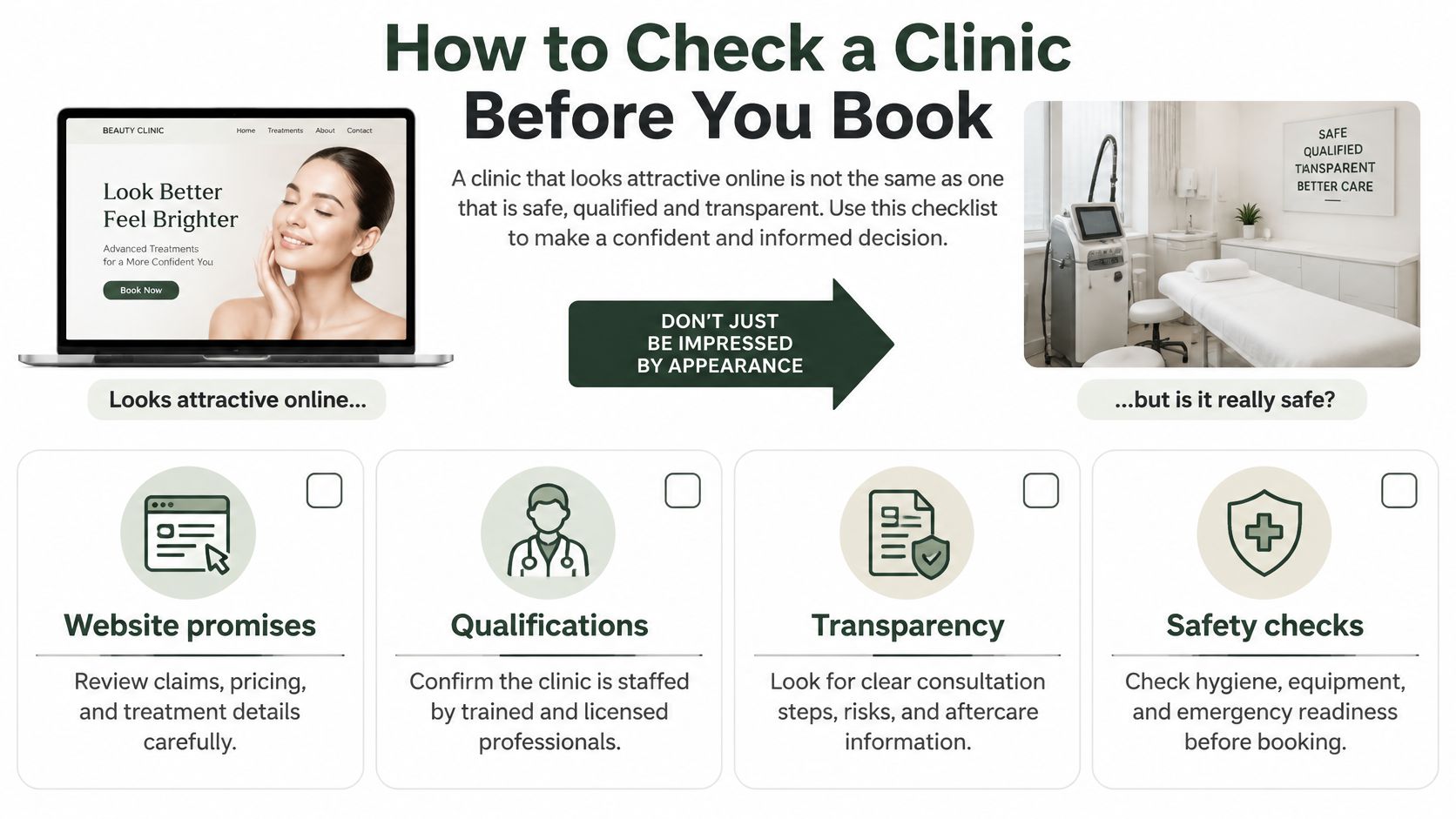
Seven questions, and why each one matters
- Is there a face-to-face consultation before any procedure? If a clinic will book you straight into a laser session, that tells you how it views assessment. Say no thank you.
- Who performs the treatment, and what are they licensed for? Yoyimé Clinic's doctors and specialists are DHA-licensed and trained to international clinical standards across dentistry, dermatology and aesthetics, and the medical team has 15+ years of combined clinical experience across dentistry, dermatology, laser and aesthetic medicine. Ask any clinic for the same detail in writing.
- Are the devices registered and maintained? Ask which platform will be used, who services it and when it was last tested. A clear answer about service records is a good sign.
- Will you receive written information on risks, complications, expected outcomes and costs? Verbal reassurance fades. A document you can take home and read is harder to argue with later.
- What is the plan if a complication occurs? A clinic should name who reviews you, how quickly, and whether that review is included.
- Are outcomes discussed realistically, or guaranteed? Guaranteed results are a warning sign, not a comfort. Misleading aesthetic advertising, including unsupported claims and digitally altered images, is one more reason to look past the marketing.
- Are the before-and-after images representative and unedited? Ask whether the images show the same lighting, the same angle and a stated time frame.
A strong clinic can be easy to miss in search results because its advantage is quiet: documented consent, clinical notes, realistic limits and a follow-up route. Device choice still matters, but it comes after these checks.
What Happens at a Doctor-Led Consultation
The first visit is an assessment, not a sales appointment, and knowing the sequence removes most of the nerves. You should leave with a written plan you understand, or with a clear reason why treatment isn't right for you yet.
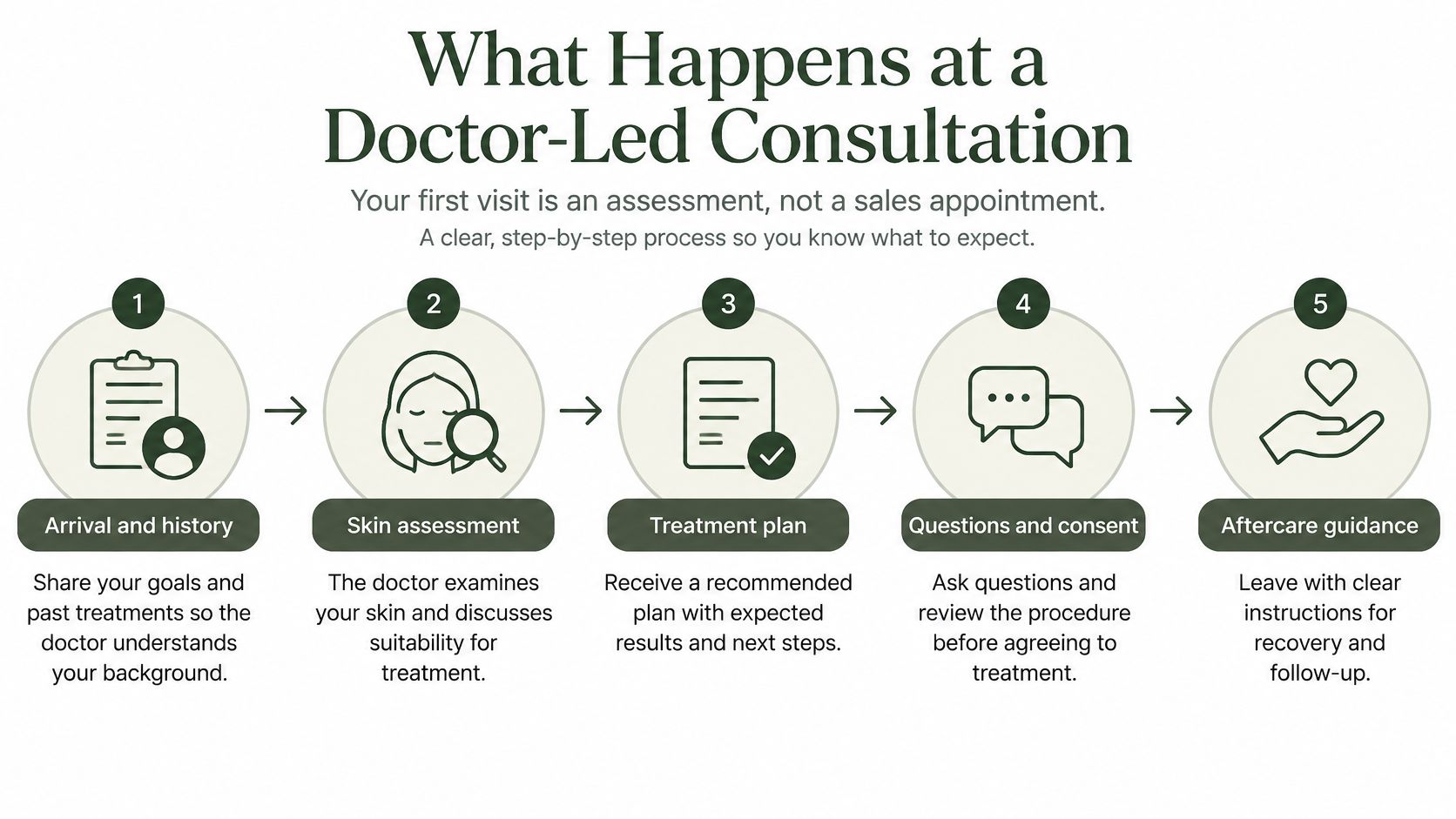
The sequence of a first visit
- Arrival and history. You'll be asked what bothers you, what you've tried, what medications you take, whether you've had fillers, lasers or peels before, and how much sun you've had lately. Answer openly, including the treatments you regret.
- Examination. The doctor assesses skin type and pigment, texture and pores, hair density where relevant, and facial lines and laxity. Expect the skin to be looked at closely under proper light.
- Indication, explained. The doctor names the option that fits, the options that don't, and the reason for each. "No procedure today" is a legitimate recommendation, particularly with active inflammation.
- A written plan. Sessions, intervals, the timeline for seeing change, maintenance, and the cost of each part.
- Consent before anything. Risks, alternatives and aftercare are reviewed before a device is switched on.
- Treatment. The session is delivered by the team member assigned to your pathway, whether that's dermatology, GP aesthetic medicine, laser nursing or aesthetics.
- Review. Progress is checked against the plan rather than against memory.
A named clinician makes this easier to picture. Dr. Junitta Jacob is a GP Aesthetic Physician with 5+ years of clinical experience at Yoyimé Clinic, and the wider team works across dentistry, dermatology, laser and aesthetic medicine. If you want to see the room and the flow before you arrive, this short walkthrough shows what the appointment looks like.
One practical advantage of a clinic that runs multiple disciplines is continuity. Yoyimé Clinic offers dental, aesthetics, laser, IV, and longevity services under one roof, so a concern about skin, hair, vitamin levels or body composition can be discussed in the same visit rather than through three separate referrals. We describe how that pathway is structured in doctor-led aesthetic clinic care and treatment options.
No consultation guarantees an outcome. What it can guarantee is that the decision was made with your skin in front of the clinician rather than on a booking page.
Safety Rules for Laser and Energy Treatments
Laser and intense pulsed light hair-reduction equipment is prescription equipment, and Dubai Health Authority requirements state it must be used under the supervision of qualified physicians. The same guidance requires informed consent before treatment, requires the treatment area to be cleared around the laser beam, and requires patients and staff to avoid looking into the primary beam or reflective surfaces (DHA laser and IPL safety guidance). A facial can be adjusted by feel. A laser cannot.
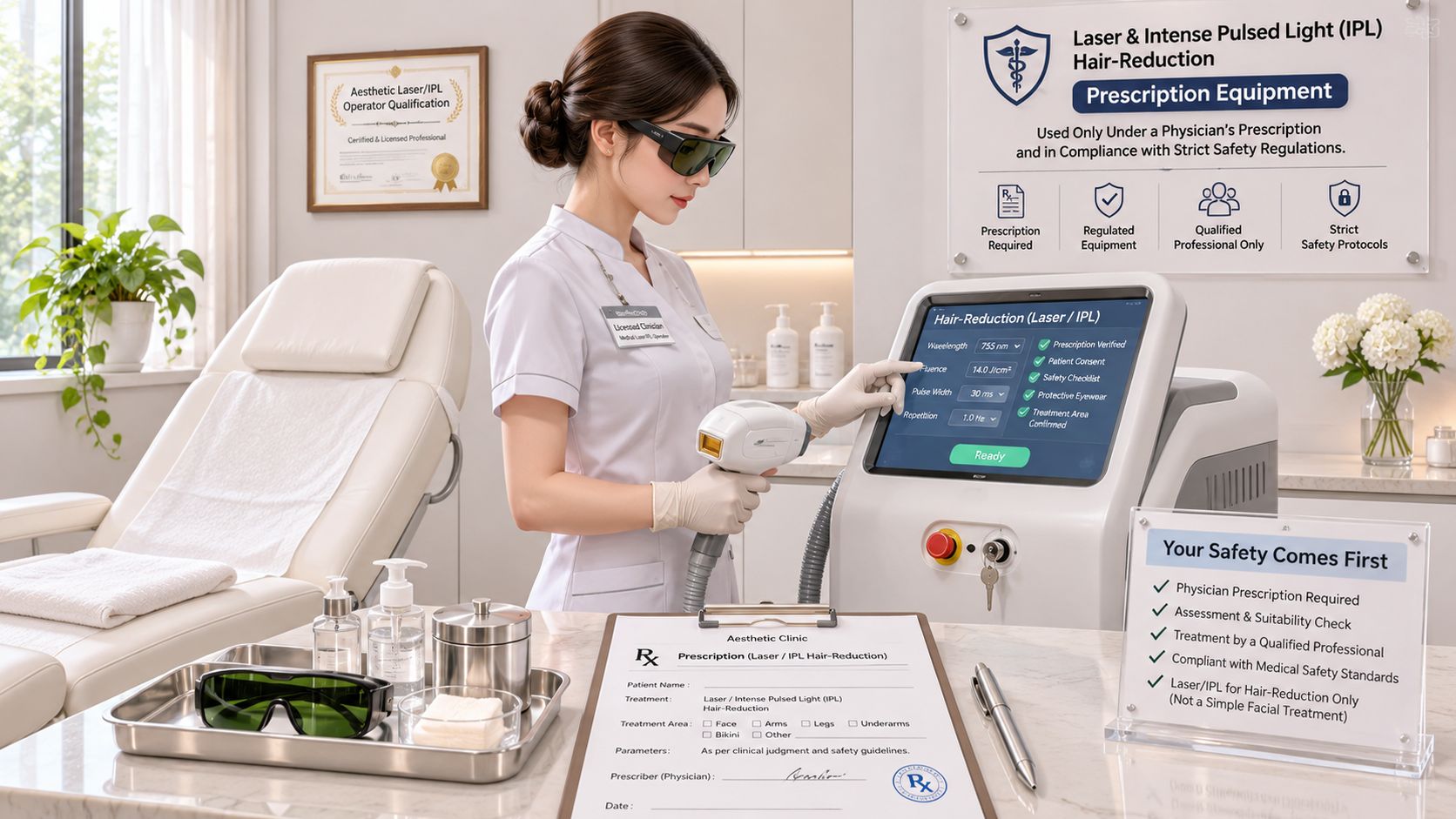
Three checks happen before any pulse is delivered. The first is skin type on the Fitzpatrick scale, which groups skin by how it responds to sun and burning. The second is recent tanning or sun exposure, because darker or freshly tanned skin may need a longer wavelength and more conservative settings. The third is cooling and settings chosen for you, with the clinician watching the skin's response during the session rather than following a default.
Wavelength choice is not branding. A comparative clinical study found that Alexandrite, Nd:YAG and diode systems each produced roughly 35–40% hair reduction at 12 months after three to six sessions, with no significant difference between groups, while the authors stressed minimising pigment change in Fitzpatrick IV–VI skin (comparative laser hair reduction study). Shorter wavelengths such as 755 nm Alexandrite are absorbed strongly by melanin, which treats pigmented hair efficiently but also raises the risk of epidermal injury on darker or tanned skin. Longer 1064 nm Nd:YAG penetrates deeper and is absorbed less by surface melanin.
What the settings conversation should sound like: your clinician names the wavelength, explains why it suits your skin type and recent sun exposure, and tells you what they're watching for on your skin during the session.
Expect several sessions, because laser only affects hair in its growth phase. Maintenance sessions are normal. Reduction is not the same as guaranteed complete removal, and any clinic promising that is overselling. We cover the fuller risk picture in laser hair removal risks. Private, low-noise treatment rooms and defined privacy protocols matter too, particularly for intimate areas.
What Drives the Cost of Treatment
Ask three clinics for the price of "a laser session" and you will get three different numbers. That spread is normal, because pricing works like a quote for any skilled work: the figure reflects what the job involves. Five factors move the number:
- The area and its size. Full legs, back and face sit in different brackets because the treated surface differs.
- The complexity of the concern. Pigment, texture and laxity need different devices and different numbers of passes.
- Sessions and spacing. Six sessions two weeks apart cost differently from three sessions six weeks apart.
- The device, and whether technologies are combined. Some plans pair a pigment-focused laser with a light-based pass in the same course.
- Maintenance after the initial plan. Top-up sessions carry their own cost, so count them in the total rather than treating the first course as the full spend.
Clinics often bundle the early steps into named packages, which changes what the entry price covers. At Yoyimé, the starter packages fold consultation and treatment planning into the first visit, so the figure you are quoted already includes the assessment rather than sitting on top of it.
| Package | What it includes |
|---|---|
| Chemical Peels Starter Package | Consultation, treatment planning and one core session for first-time visits |
| IV Therapy Starter Package | Consultation, treatment planning and one core session for first-time visits |
| Complete Facial Rejuvenation Package | A staged plan for overall facial renewal |
Prices for these packages are confirmed at consultation rather than published as fixed figures, because the contents depend on your assessment. Payment can be spread through a 4 interest-free option with no late fees, which is Sharia compliant.
Before you pay: ask for the session count, the interval between sessions, the cost of each part and what maintenance will involve, all in writing.
The habit that protects you is comparing total plan cost rather than the entry price of a single session. A cheaper session that needs repeating more often, or that covers too small an area to make a difference, costs more across the full course. If a clinic can put the whole plan in writing, the number is checkable. If it cannot, the quote is not finished.
Questions Patients Ask Before Booking
These come up in almost every first visit, so here are direct answers.
Is aesthetic treatment painless? No. Comfort varies by treatment, by device and by person, and the clinician will explain how discomfort is managed for the specific option you choose.
How many sessions will I need? It depends on the concern, your skin type and the device, which is why the number belongs in a written plan rather than a verbal estimate.
Is laser hair removal permanent? Laser targets hair in its growth phase, so change is gradual, several sessions are usually needed, and maintenance is normal. Complete removal isn't guaranteed.
Can I have treatment if I have active acne or melasma? That's a consultation decision, because active inflammation and pigment change which options are safe and in what order.
Do I need a consultation before a single treatment? Yes. Non-surgical cosmetic procedures in Dubai require a face-to-face consultation first.
Do I need a blood test before IV therapy? A blood test can confirm vitamin D status before supplementation or IV planning, because symptoms alone cannot establish deficiency. In a UAE community-based study of 216 adults, 74% had a serum 25-hydroxyvitamin D level of 30 nmol/L or lower (UAE community vitamin D study).
What is recovery like? Redness, swelling or sensitivity varies by treatment. You leave with written aftercare covering sun protection, skincare and when to call the clinic.
Practical rule: none of these answers replace your own examination. They tell you what to ask, not what will happen.
Book a Consultation at Yoyimé Clinic in Deira
The practical details come first, because a good clinic should be easy to reach and easy to question.
| Detail | Information |
|---|---|
| Location | Ground Floor, Exit 1, Salah Al Din Metro Station, Deira, Dubai (106 Salah Al Din St) |
| Opening hours | Daily, 10:00 to 22:00 |
| Phone | +971 4 884 3396 or +971 50 225 7535 |
Metro access matters in Deira. Arriving by train means you don't need parking, and evening hours to 22:00 suit people coming after work.
Bring a list of medications, any treatments you've had in the past two years, and the concerns you want to raise, including the ones you feel awkward about. Mention recent sun exposure or a holiday in the past month, since that changes how laser settings are chosen. If you're weighing up several services at once, note that Yoyimé Clinic offers dental, aesthetics, laser, IV, and longevity services under one roof, so those conversations can happen in a single visit.
Nothing about the visit obliges you to proceed. The point of the consultation is to understand what's suitable, what it would involve and what it costs before you decide.
Choosing a clinic is a verification exercise, and it works best in person. At Yoyime Clinic in Deira, aesthetic care starts with a doctor-led consultation where your skin is examined, your options are explained along with their limits, and the plan and cost are set out before anything begins. Visit Yoyime Clinic to book that first conversation and decide with full information rather than a discount banner.